The Strategic Use of Climate Vulnerabilities in Contemporary Conflicts: Modalities and Feedback Effects
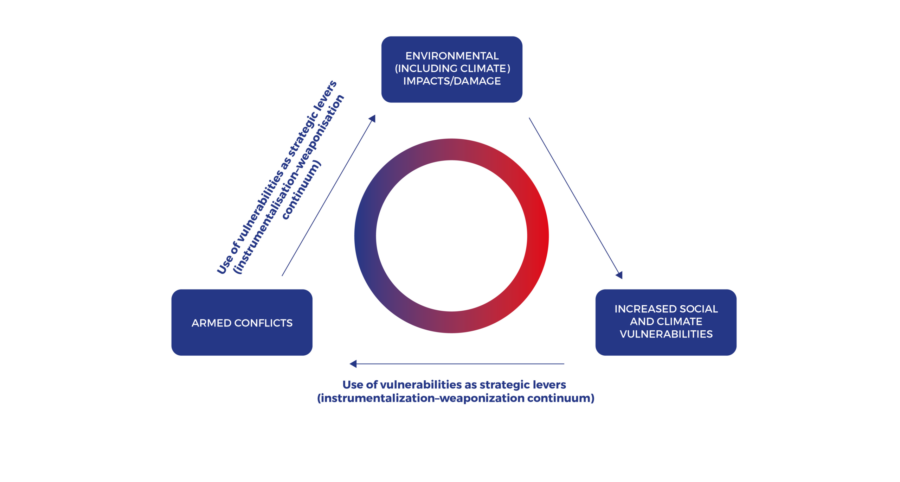
This note from the Defence and Climate Observatory proposes to move beyond the dominant debates on the climate-conflict nexus focusing on the role of climate change as a direct or indirect factor in conflicts, by concentrating on the interaction between climate issues and conflict dynamics. It analyses case studies of contemporary conflicts to understand how climate vulnerabilities are used as a strategic lever in conflict contexts, within a continuum of instrumentalisation-arsenalisation (I), the environmental damage caused by conflicts, also instrumentalised by the belligerents, and their security and strategic implications (II). Finally, the note proposes three forward-looking scenarios, accompanied by strategic recommendations for the French Ministry of the Armed Forces (III).

Since the early 2000s, climate issues have become a central focus of states’ foreign and domestic policies and have been gradually integrated by security and defence actors, particularly through the concept of climate security. However, this dynamic is now facing certain obstacles, notably discourse highlighting a tension between defence priorities and climate change considerations, leading to the latter being deprioritised. Yet a joint analysis of security and climate issues appears essential in view of the current geopolitical and environmental context. Indeed, we are seeing the (re)emergence of the concepts of ‘high-intensity’ conflicts and ‘hybrid warfare’ to characterise the changing nature of contemporary conflicts. At the same time, climate change continues to intensify, now faster than initially predicted.
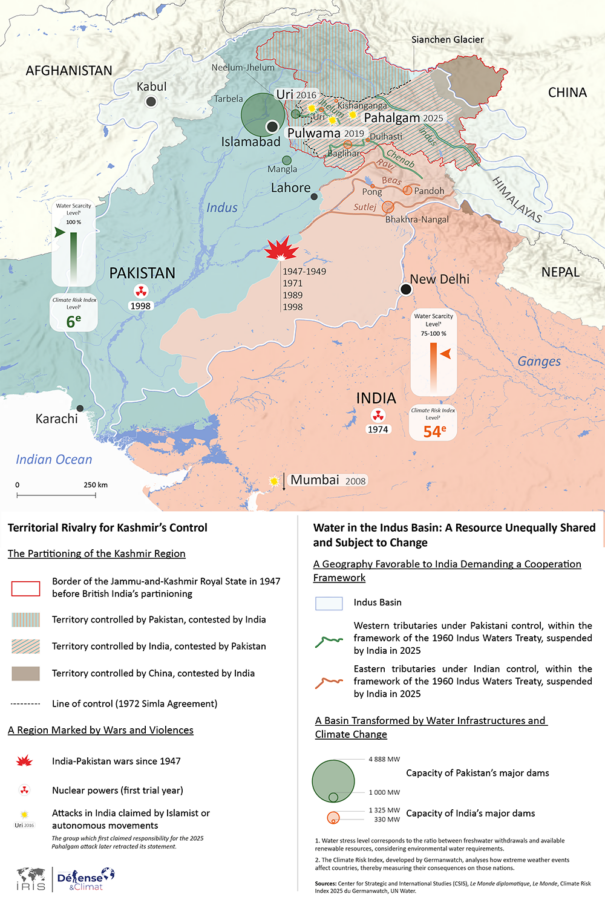
By examining the interaction between climate issues and conflict dynamics, this note reviews several case studies of these issues in India and Pakistan, around Lake Chad, in Russia, and in Yemen.
Map 1: The Indo-Pakistani Conflict over Kashmir: Between Territorial Rivalries and Vulnerabilities
Map 2: Mapping of the targeting of agri-food infrastructures by the international coalition in the Yemeni civil war (March 2015 – May 2025)
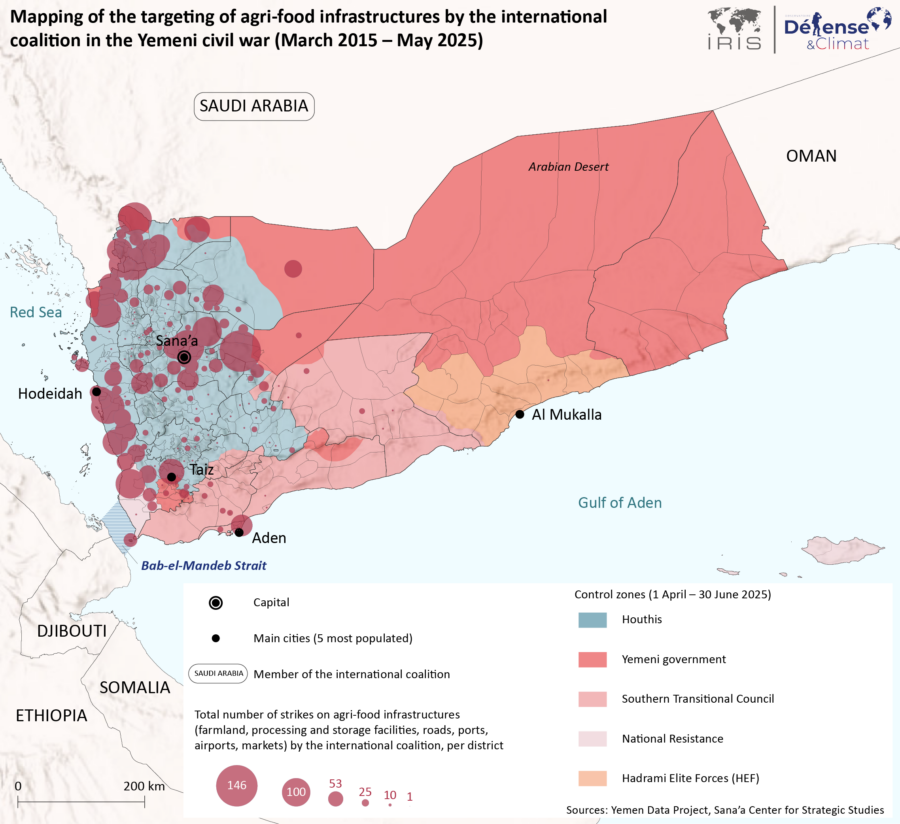
Figure: “Conflict, Climate, and Environment” Feedback Loop