Russian Climate Opportunism: Geopolitical and Security Implications
This paper lies at the intersection of climate and geopolitical issues. It analyses how Russia incorporates climate change into a logic of “climate opportunism” in pursuit of its strategic objectives. This approach results in a degree of divergence between how climate issues are addressed at the national and international levels.
This report examines the environmental consequences of climate change, as well as its economic implications for Russia. It also looks at how climate issues are addressed at the international level, to illustrate Russia’s various developments within the framework of climate multilateralism, and analyses the integration of climate change at the national level, particularly within the defence sector.
The consequences of climate change on interstate relations are ambivalent. As a global phenomenon, climate change can foster cooperation between states, since it requires coordinated and effective climate policies. Conversely, it can also compound existing tensions and intensify rivalry and competition between actors. This tendency is all the more perceptible in the contemporary context, which is marked by a hardening of interstate relations and a questioning of the multilateral order inherited from the Second World War. The current context therefore appears conducive to the instrumentalisation of climate change : some state actors go so far as to exploit it coercively, using it as a strategic lever in the same way as economic, technological or industrial issues.
Consequently, the integration of climate issues is not uniform. It is marked by a divergence between the international and national levels. At the international level, climate change served as a means of integrating into the liberal world order until the early 2010s. Since then, it has been used to undermine the credibility of Western countries on climate matters, particularly their moral credibility. By taking part in climate multilateralism, Russia can promote certain domestic rhetoric and narratives. At the national level, climate change is perceived as both an opportunity and a threat, depending on the groups concerned. These include actors from the hydrocarbon and metallurgical sectors, politicians close to these industries, and President Vladimir Putin himself. As a result, these divisions have led to the absence of a coordinated national policy to tackle climate change.
Map : Russia and Climate Change
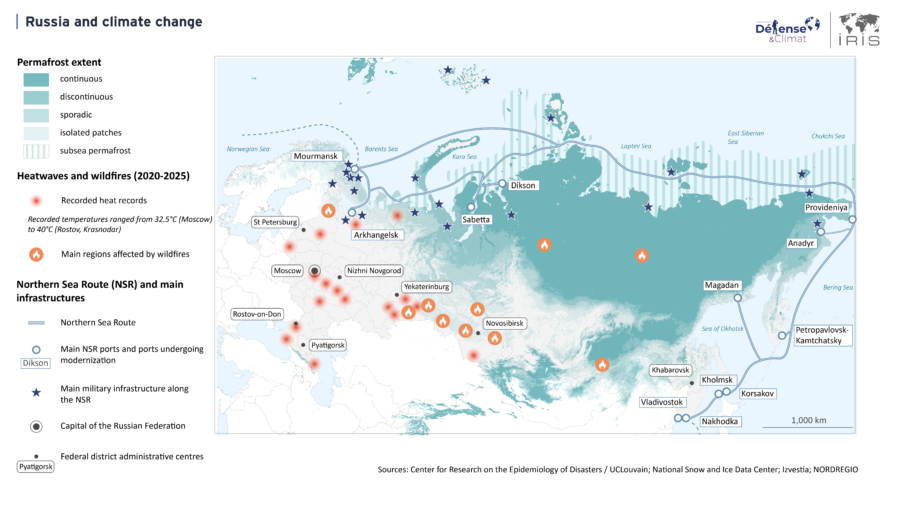
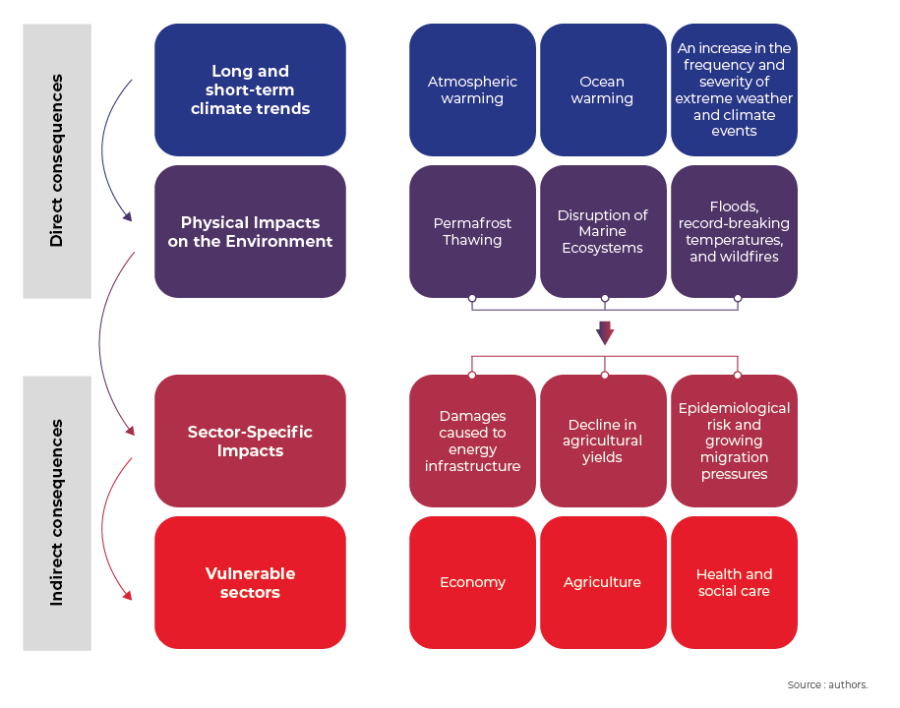
Chart : The Ripple effects of Climate Change on Russia